HPWH Systems for Process Hot Water Electrification
Decarbonizing process hot water requires advanced system design. Heat Pump Water Heaters (HPWH), paired with Thermal Energy Storage (TES) and Waste Heat Recovery (WHR), deliver high-temperature process hot water (up to 180°F+) at ultra-high efficiencies—all while slashing peak electrical demand and operating costs.
Heat Pump Water Heaters (HPWH): Water-Source & Air-Source
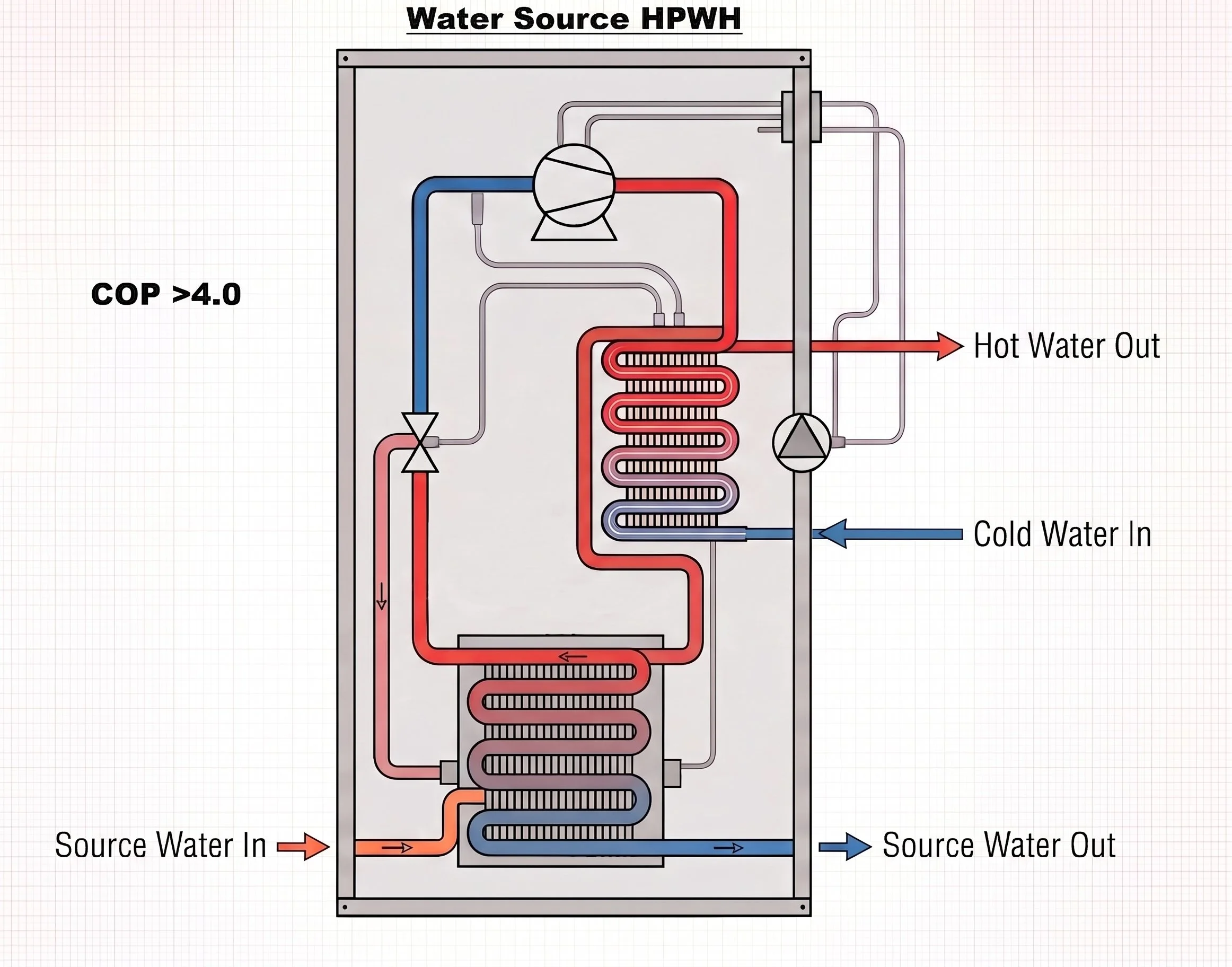
A Water-Source HPWH (WS-HPWH) extracts thermal energy from a liquid water loop (such as process effluent, condenser water, cooling tower loops, or solar thermal panels) and elevates it to produce hot process water. The Source Water In & Out allow these types of HPWHs to be used with Waste Heat Recovery and Combined Heating & Cooling.
Because water has over 4,000 times the volumetric heat capacity of air, liquid heat sources stay warmer and more stable year-round. This allows WS-HPWH units to operate at higher evaporator temperatures, resulting in vastly superior thermal output, smaller equipment footprints, and Coefficients of Performances (COPs) of 4.0 to 6.0+.
The 4-Step Water-to-Water Cycle:
Heat Extraction (Evaporator): Warm source water (65°F–120°F) passes through a liquid-to-liquid heat exchanger, transferring its heat to the refrigerant vapor.
Pressure & Temp Elevation (Compressor): The electric compressor compresses the refrigerant gas, driving its temperature up to 160°F–200°F.
Hot Water Delivery (Condenser): The superheated refrigerant passes through a second heat exchanger, heating incoming cold process water to target temperatures (140°F–180°F+).
Pressure Reset (Expansion Valve): The refrigerant expands, drops in pressure and temperature, and returns to the evaporator loop to continuously extract heat.
An Air-Source HPWH (AS-HPWH) works similarly to a WS-HPWH, by extracting thermal energy from outside air and elevating it to produce hot process water, with Coefficients of Performances (COPs) of 3.0 to 4.0. However, these types of HPWHs typically cannot be used with Waste Heat Recovery and Combined Heating & Cooling.
System Efficiency & Coefficient of Performance (COP)
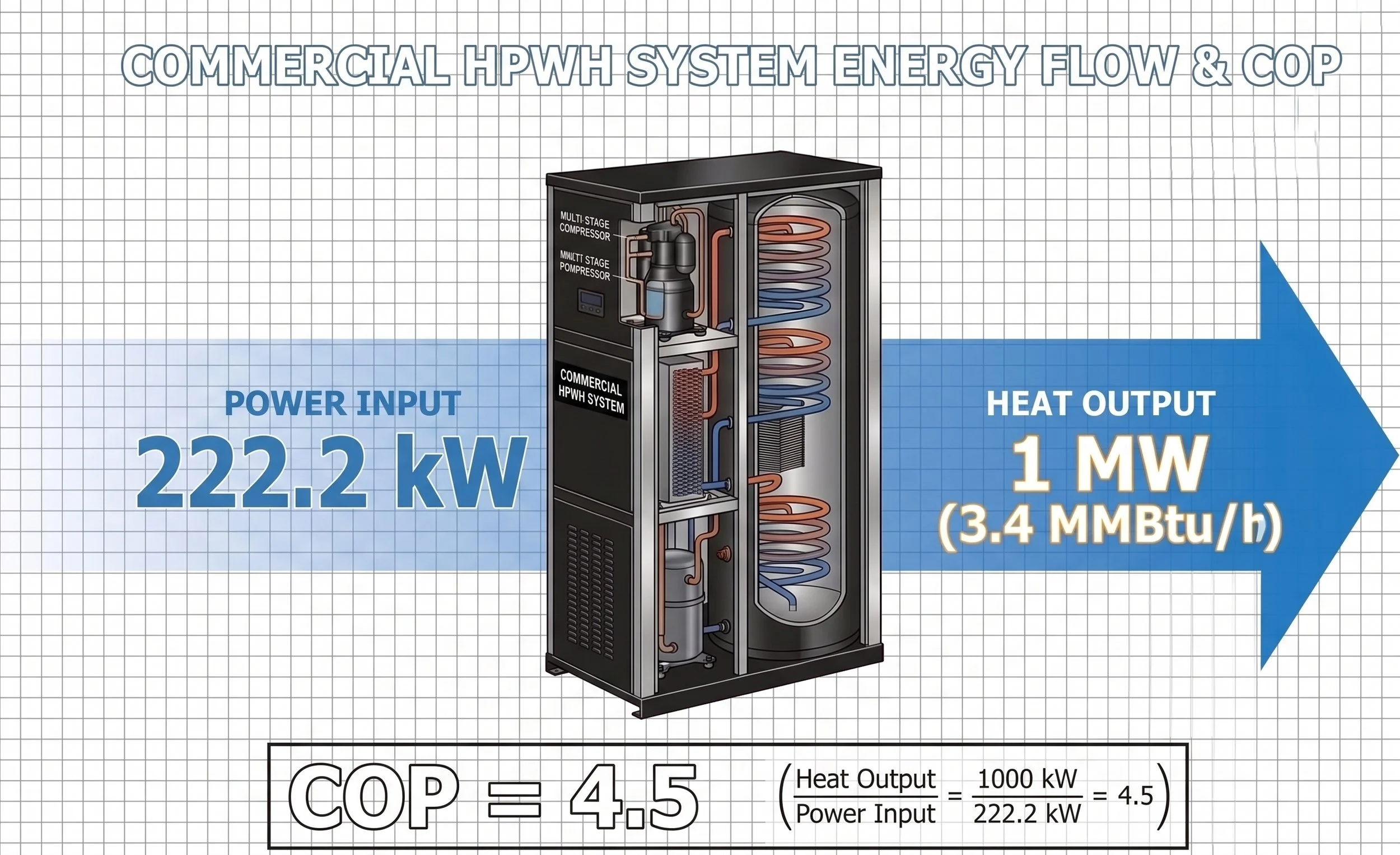
Efficiency in thermal heating is measured by Coefficient of Performance (COP)— the ratio of useful heat output to electrical energy input.
Natural Gas / Propane Boiler: COP 0.80–0.92 (80%–92% efficiency due to flue gas losses).
Electric Resistance Water Heater: COP 0.98–1.0 (98%–100% efficiency; converts 1 kWh of electricity directly to 1 kWh of heat).
Air-Source HPWH: COP 2.5–3.5 (250%–350% efficiency; varies with outdoor ambient air temperature).
Water-Source HPWH: COP 4.0–6.0+ (400%–600%+ efficiency; stable year-round performance).
Understanding COP Impact: At a COP of 4.5, for every 1 kWh of electricity consumed by the heat pump compressor, 4.5 kWh worth of thermal energy is delivered into your process hot water system.
Thermal Energy Storage (TES)
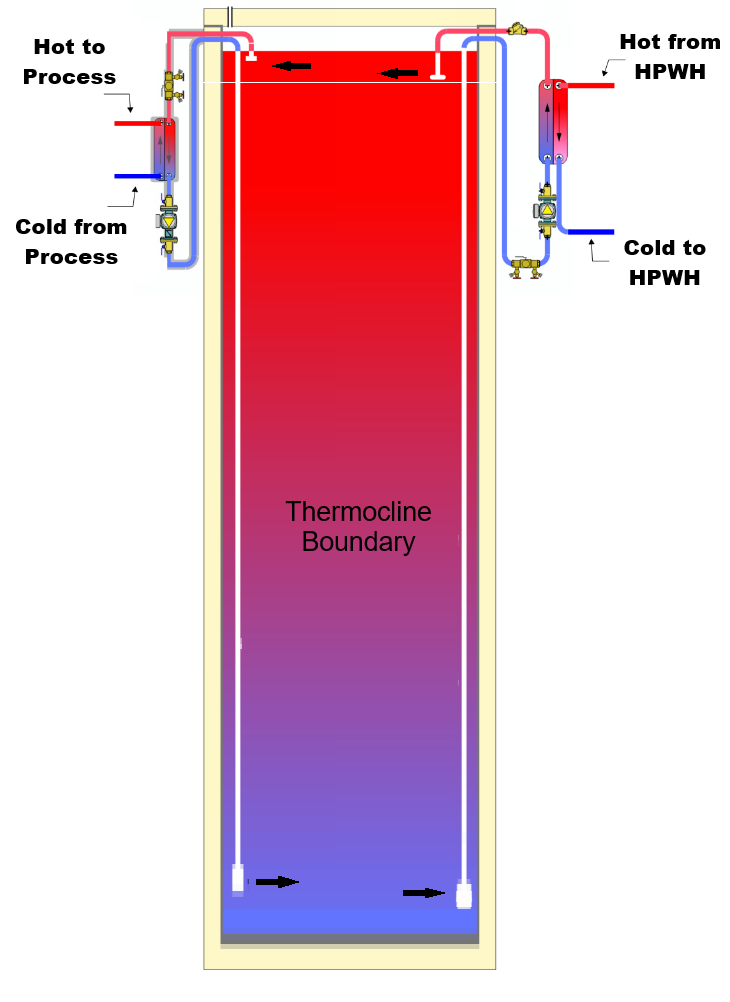
Thermal Energy Storage (TES) uses insulated vessels, typically pressurized or unpressurized water tanks, to decouple heat production from peak facility water usage. They are a critical part of a HPWH system and need to be carefully optimized during the engineering design phase.
Stratification: Correctly sized and proportioned tanks are critical for optimal stratification, which maximizes the amount of thermal energy stored.
Peak Electric Demand Shaving: Heat pumps operate continuously during off-peak hours (nighttime/super-off-peak rates) to charge thermal storage tanks.
Capital Cost Reduction: Allows facility managers to install a smaller WS-HPWH unit sized for average daily load rather than massive surge peak GPM.
Electrical Infrastructure Protection: Minimizes transformer and main service panel upgrades by reducing total instantaneous electrical demand.
Waste Heat Recovery (WHR)
Commercial & Industrial facilities potentially reject thousands of BTUs of high-grade waste heat daily through washdown water, pasteurizers, clean-in-place (CIP) systems, and process cooling lines.
Ideal Heat Source for WS-HPWH: Capturing 85°F–120°F wastewater effluent and feeding it directly to the WS-HPWH evaporator loop creates an ideal high-temperature heat source.
Maximum COP Output: Higher entering source water temperatures reduce the pressure lift required by the compressor, driving COP efficiency levels past 5.5–6.5.
Eliminates Weather Sensitivity: Because process waste streams run continuously indoors, heating capacity remains 100% stable regardless of outdoor winter weather.
Combined Heating & Cooling (CHC)
Food processing plants, cold storage centers, breweries & wineries, and commercial facilities routinely run heavy refrigeration plants (ammonia/CO₂/freon) or chillers to generate space/process cooling while simultaneously burning natural gas in boilers to make hot water.
Combined Heating & Cooling (CHC) integrates the WS-HPWH directly with the refrigeration system's condensing loop:
Dual-Duty COP (Total System COP > 7.0–8.0): Instead of venting rejected refrigeration heat to the atmosphere via evaporative cooling towers or air-cooled condensers, the heat pump absorbs that rejected heat and pumps it up to hot process water temperatures.
Pay Once, Get Both: For 1 kWh of electrical input, the combined system delivers both a unit of process cooling AND a unit of process hot water simultaneously.
Water & Chemical Savings: Diverting heat away from cooling towers reduces evaporative water loss, drift, and water treatment chemical costs.